
Water with safety for your project
Well Drilling
Complete artesian well drilling, with technology, a specialist team and full compliance with technical standards.
- Standards compliance
- Specialist team
- Modern equipment
- Solutions for different needs
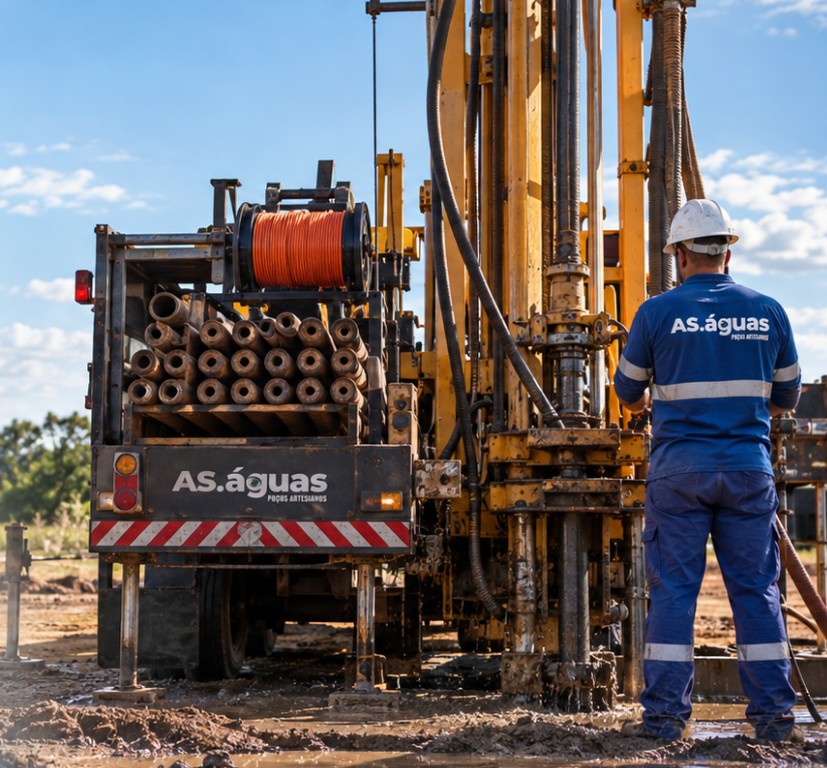
A commitment to every drop of water.
Well types
Sediment:
Water can also be collected from sedimentary layers, where the well is fully cased.
-
Ground: Sedimentary layers (sand, clay)
-
Casing: 100% cased (steel or PVC pipe)
-
Intake: Special screens + silica pre-filter
Rock:
A deep tubular well is an engineering work built to tap groundwater, drilled vertically with drilling rigs, with varying depths and yields (productive capacity, volume of water). Where the ground is crystalline rock, water is collected from fractures or fissures, so the well is only partly cased.
-
Ground: Crystalline rock (granite, gneiss)
-
Casing: Partial (only through the soil layer)
-
Intake: Natural fractures and fissures in the rock
Mixed:
Mixed wells are those drilled through sedimentary rock in the upper section and crystalline rock below. Like a sediment well, casing and screens are placed in the permeable, porous zone, while the lower section — the fractured crystalline aquifer — is left open. The design depends on the geology of the site.
-
Ground: Transition (sediment over rock)
-
Casing: Mixed (cased at the top, open at the base)
-
Intake: Screens at the top + open intake at the base
More water for a better tomorrow
How Well Drilling Works
Stages of the process in Brazil, from the first analysis to well operation.
Artesian wells for a healthier Brazil
-
1
Service and diagnosis
We understand the client’s need, the water demand and the conditions of the site.
-
2
Site study
We review geological and hydrogeological data and, when needed, a geophysical study to define a better point.
-
3
Feasibility and permitting
We check the legal requirements of the state, documents, licenses and the steps for drilling and groundwater use.
-
4
Design and location
We define the technical design, estimated depth, diameter and field positioning.
-
5
Drilling
We drill with suitable equipment, following technical and safety criteria.
-
6
Casing and screens
We install casing, screens and sanitary protection to keep the well sound.
-
7
Development and cleaning
We clean and develop the well to improve yield and remove drilling residue.
-
8
Yield and quality tests
We run pumping tests and water analysis to assess yield, level and quality.
-
9
Installation and automation
We install the pump, panel and piping and, when requested, telemetry and monitoring.
-
10
Delivery and operation
We deliver the well ready for use, with guidance on operation, maintenance and final permitting.
Want to understand the best solution for your property?
Talk to AS Águas.
- Experience and trust
- Solutions built to measure
- Commitment to the environment
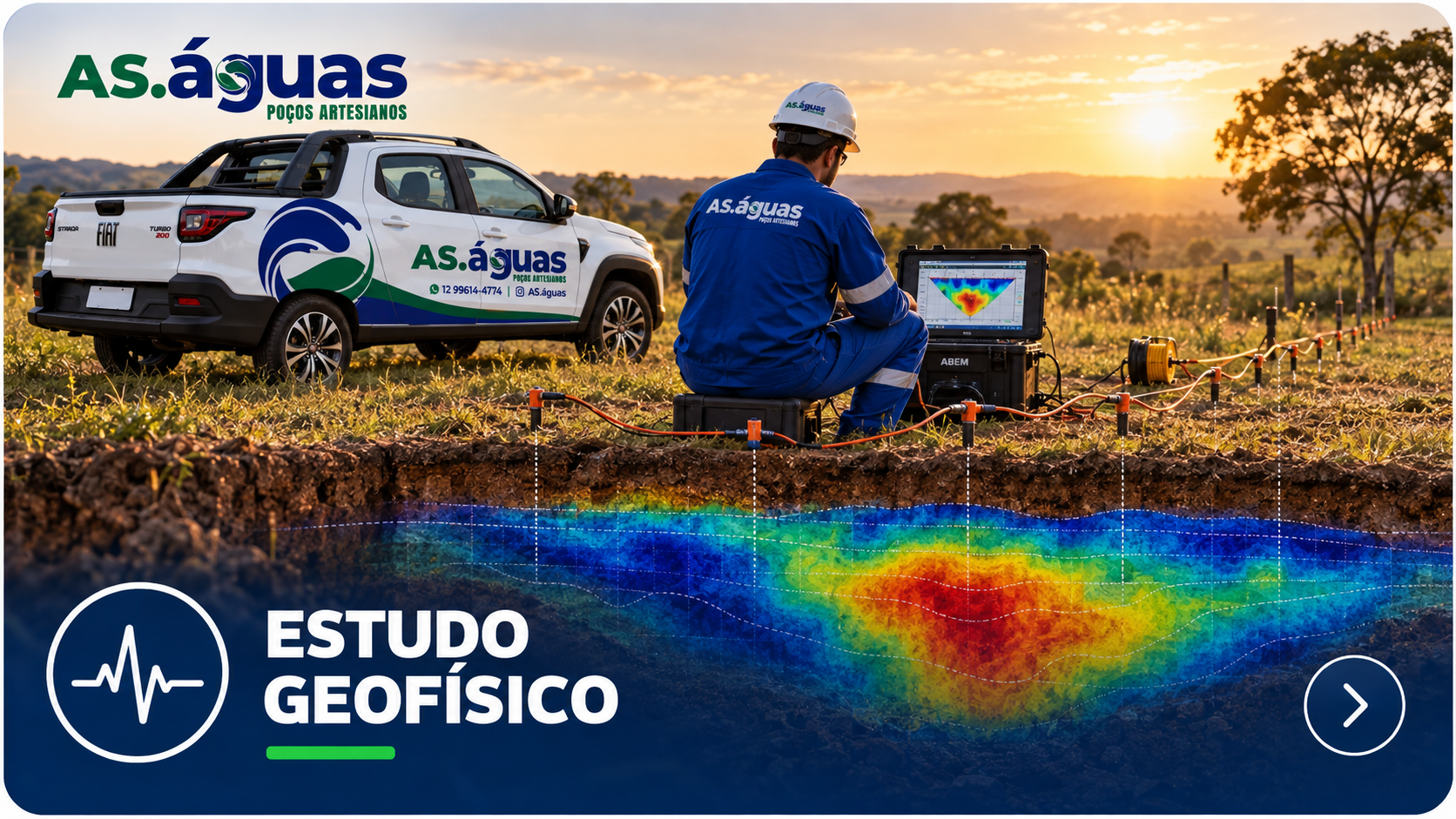
Geophysical study
Before drilling, Localizágua investigates the subsurface to guide the well location. The study does not remove every risk, but it reduces uncertainty and improves the chance of a better point.
See the geophysical studyAn integrated process, not only a construction step
Drilling an artesian well does not start when the rig arrives. Before that there is a technical process: diagnosis of the need, site study, feasibility, permitting and project definition.
At AS Águas each stage is planned so the well is built with safety, efficiency and reliability. After the best point and the project characteristics are defined, we move to drilling, casing and screens, development and cleaning, yield and water-quality tests, equipment installation and, when included, automation and telemetry.
A poor decision at the start can compromise performance, safety and the life of the well. That is why drilling is treated as an integrated process.
Execution follows the applicable ABNT standards, from planning to delivery and operation. The result is a solution matched to each property and to the real supply need.
Planning, execution and control: the path from groundwater to water security.
Permitting
A drilled well is not automatically a permitted well. Groundwater abstraction is controlled by the states and the Federal District. AS Águas guides the documents, the technical information and the filing with the competent authority.
Team and technical authority
The work is led by field specialists. Emerson, a master driller and founder of the Perfurador de Sucesso project, and Vânia Plaza Campos, connected to the history of Bombas Leão, represent this mix of practice and industrial tradition.
Safety and ABNT standards
Services follow the standards that apply to well construction, especially ABNT NBR 12212 and ABNT NBR 12244.
A warranty that continues after delivery
Google reviews
Trust in AS Águas shows up in the field and in the reviews of people who have hired the company.
Proven field capacity
Projects under different geological and operational conditions, in Brazil and abroad.
Industry, buildings and continuous supply
Deep tubular wells for operations that cannot interrupt their water supply.
Agribusiness and private land
Projects sized to the real need of each site, with control of every construction stage.
Great depth and restricted access
Equipment and method for tight spaces and drilling that demands more from the field structure.
Work outside Brazil
International experience across different geologies and operating conditions.
Frequently asked questions
Does drilling start when the rig arrives?
No. Before the work there is a diagnosis, a site study, a feasibility review, permitting and a defined project.
What is the drilling warranty?
Five years on the construction aspects, within the conditions of the contracted service and the applicable ABNT standards.
Is geophysics part of the process?
Yes. Localizágua investigates the subsurface to guide the location and reduce uncertainty before drilling.
Do you handle permitting?
Yes. Permitting is part of water security and follows the authority of each state or the Federal District.
Do you work only in São Paulo?
No. The work is national and includes international projects.
How do I request a quote?
On WhatsApp, by phone at (12) 3903-9100, or through the contact form.